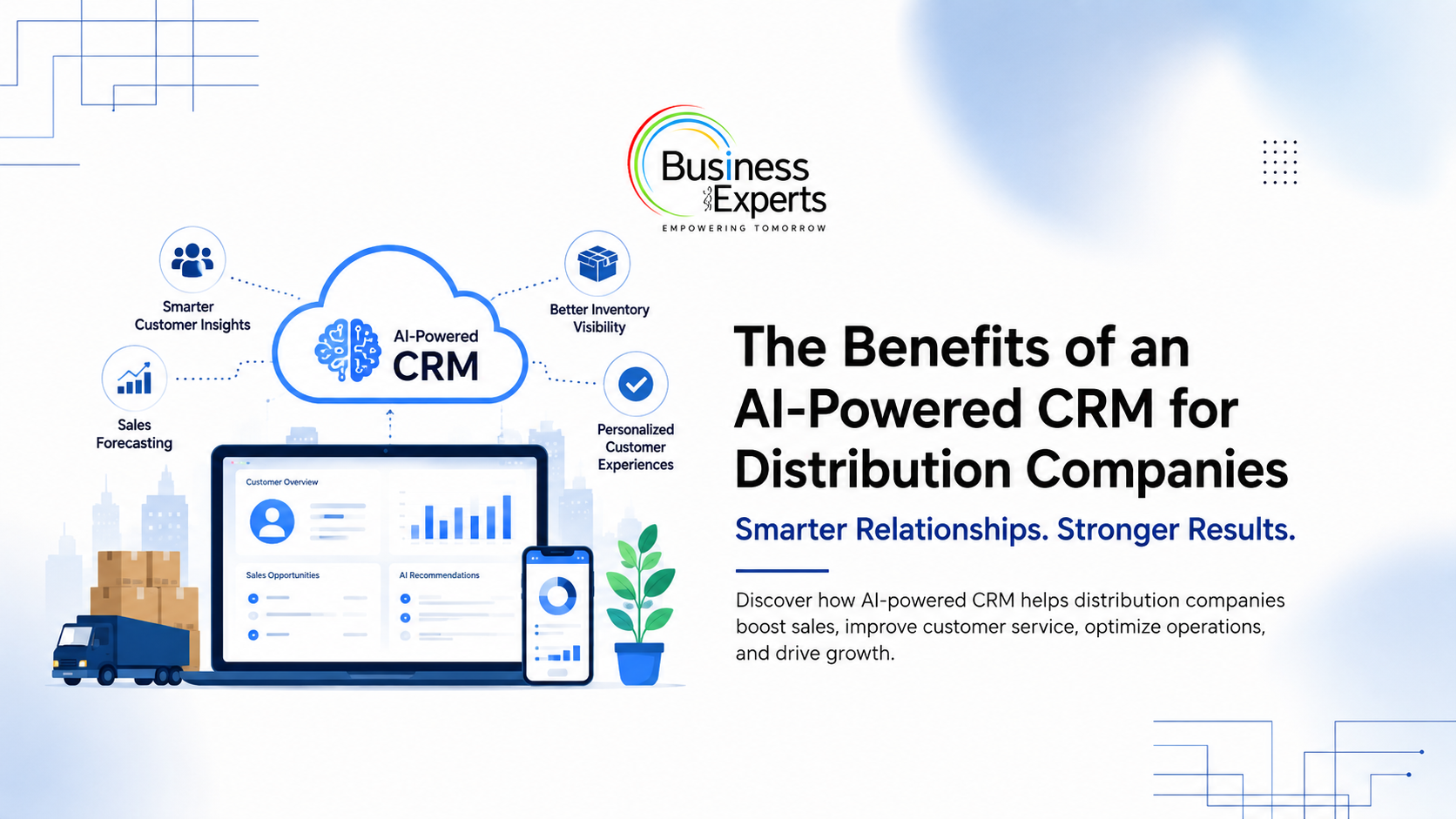
💡 Key Takeaways
Distribution businesses manage complex networks of customers, suppliers, sales teams, field representatives, and internal operations. As these operations grow, customer and sales information can become fragmented across ERP systems, spreadsheets, emails, and other applications. A CRM brings this information together and creates a connected view of customer activity, sales opportunities, service interactions, and account performance.
Key Benefits of CRM for Distribution Companies
CRM can create value across sales, account management, customer service, and business planning. The main benefits include:
- Improved sales visibility: Monitor opportunities, pipeline stages, account activity, and sales performance.
- Better forecasting: Use structured opportunity data to improve revenue and demand planning.
- Stronger account growth: Identify cross-selling, upselling, and customer retention opportunities.
- Connected business data: Integrate CRM software with ERP, inventory, finance, and other systems.
- Higher sales productivity: Automate repetitive tasks, follow-ups, approvals, and workflows.
- Better field performance: Give sales representatives access to customer intelligence from anywhere.
- Scalable sales operations: Standardise processes across teams, regions, and business units.
How CRM Creates Value for Distribution Businesses
The value of CRM for distributors comes from connecting customer-facing processes with the wider business environment. Instead of treating sales information as a separate data set, CRM can bring together customer activity, opportunity data, service interactions, and relevant operational information.
Improve Sales Pipeline Visibility
CRM helps distribution teams manage opportunities across products, territories, customer segments, and sales teams.
- Track opportunities, stages, values, and closing dates.
- Identify stalled deals and pipeline gaps.
- Prioritise high-value opportunities and sales activities.
Improve Sales Forecasting
CRM provides structured sales data that can support more reliable forecasting and planning.
- Track expected revenue and deal progress.
- Improve visibility into future sales.
- Support purchasing, inventory, and fulfilment planning.
Strengthen Account Management
CRM brings customer contacts, interactions, opportunities, and service information into a single account view.
- Maintain a complete view of key customer accounts.
- Identify cross-selling and upselling opportunities.
- Track account activity and engagement.
Increase Sales Productivity
CRM automation can reduce repetitive administrative work and help sales teams manage their activities more efficiently.
- Automate follow-ups, reminders, and task assignments.
- Reduce manual data entry and reporting.
- Give sales teams more time for customer engagement.
Key CRM Use Cases for Distribution Companies
CRM can support multiple stages of the distribution sales and service cycle. Its role becomes more valuable when these customer-facing processes are connected with the organisation’s operational systems.
Managing Complex Sales Pipelines
CRM allows distributors to manage opportunities across different products, regions, customer groups, and representatives. Teams can track opportunity progression, next actions, expected revenue, and customer engagement from a central platform.
Identifying Cross-Sell and Upsell Opportunities
Customer purchase history, product interests, account activity, and previous interactions can reveal opportunities to expand existing accounts. CRM allows these signals to be captured and used within the sales process.
Managing Field Sales Operations
Field representatives need access to current customer and opportunity information when visiting accounts. Mobile CRM allows them to review account history, update opportunities, record meeting outcomes, and create follow-up activities from the field.
Managing Customer Service
Customer enquiries and complaints often involve both service and sales teams. CRM can centralise service requests, interactions, assigned activities, and customer history so that authorised employees can access the relevant context.
Integrating CRM with ERP and Business Systems
A CRM should complement the ERP rather than operate as another isolated system. Integration can connect customer-facing information with operational data such as inventory, product availability, pricing, orders, fulfilment, and account transactions.
For distributors, this creates a more complete view of the customer and commercial relationship. Sales teams can access relevant information without constantly switching between applications, while each system continues to manage the processes it was designed for.
Microsoft Dynamics 365 for Distribution
Microsoft Dynamics 365 can connect CRM capabilities with the wider Microsoft ecosystem, including business applications, analytics, automation, and cloud services. This can be particularly valuable for distributors already using Microsoft technologies across their organisation.
The platform itself is only one part of the implementation. Integration architecture, data migration, process configuration, security, reporting, customisation, and user adoption all influence the value the business receives from the solution.
Building a Scalable CRM Strategy with BEMEA
For distribution companies, CRM can become a strategic layer connecting customer intelligence, sales execution, and operational data. The strongest value comes from better pipeline control, account visibility, forecasting, productivity, and decision-making rather than simply storing customer information.
BEMEA helps distribution businesses implement Microsoft Dynamics 365 and connected Microsoft solutions across CRM, Power BI, Azure, and Power Platform. With a focus on aligning technology with commercial processes, BEMEA supports businesses in building connected, scalable, and data-driven operations.
FAQs
What are the main benefits of CRM for distribution companies?
CRM can improve sales pipeline visibility, forecasting, account management, customer service, field productivity, and workflow automation. It also provides a structured way to connect customer information with ERP and other operational data.
Can CRM integrate with ERP and inventory systems?
Yes. CRM platforms can integrate with ERP, inventory, finance, warehouse, and other business systems through APIs, connectors, middleware, or other integration approaches. The implementation should define clear data ownership and determine which information needs to be exchanged.
How does CRM improve sales forecasting?
CRM captures opportunity values, sales stages, expected closing dates, activities, and customer engagement in a structured format. This provides management with a more consistent view of the pipeline and can improve the basis for revenue forecasting.
Can CRM help distributors increase sales from existing customers?
Yes. CRM can help identify potential cross-selling, upselling, reactivation, and retention opportunities by bringing together customer activity, purchase history, product interests, and sales interactions.
Is CRM useful for field sales teams?
Yes. Mobile CRM allows field representatives to access customer records, opportunities, activities, and account history while working remotely. They can also update records immediately after customer interactions.
What should distributors consider when implementing CRM?
Key considerations include integration, data migration, workflow design, security, analytics, scalability, user adoption, and ongoing support. The CRM should be aligned with existing commercial processes and the wider technology environment.
Why consider Microsoft Dynamics 365 for a distribution business?
Microsoft Dynamics 365 provides CRM capabilities that can connect with Microsoft’s wider ecosystem of analytics, automation, cloud services, and business applications. This can help organisations create a more connected technology environment across commercial and operational functions.