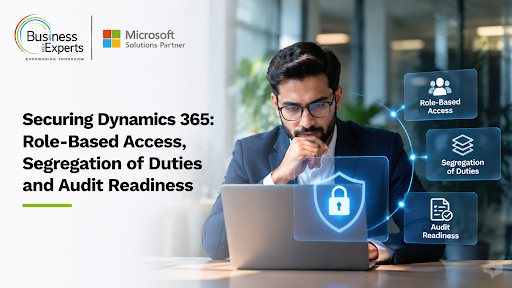
Microsoft Dynamics 365 brings important business processes, financial information and operational data into a connected environment. However, having this information in one system also makes access control an important part of business security. Without clearly defined permissions and responsibilities, users may gain access to information they do not need, perform conflicting tasks or make changes that are difficult to trace during an audit.
Understanding Role-Based Access Control in Dynamics 365
Role-Based Access Control (RBAC) determines what users can access and which activities they can perform within Dynamics 365. Instead of granting permissions individually, administrators assign security roles based on employees’ responsibilities. This helps businesses maintain consistent access policies while ensuring that users have the permissions needed to perform their jobs.
In Dynamics 365 Finance and Operations, the security model follows a hierarchy of four components:
- Permissions: Define access to individual application elements, such as forms, tables, fields and services.
- Privileges: Group permissions required to perform a specific task.
- Duties: Combine related privileges that support a particular business responsibility or process.
- Security Roles: Bring together duties and privileges to define the access available to a user.
Microsoft Dynamics 365 also supports data-level security controls, allowing organisations to restrict access to specific records or business data where required. This adds another layer of protection beyond controlling access to application functions.
Why Segregation of Duties Matters in Dynamics 365
Role-based access determines what employees can do, while Segregation of Duties (SoD) ensures that conflicting responsibilities are not assigned to the same person. This is an important internal control for businesses handling financial transactions, procurement, inventory and other sensitive operations.
Segregation of duties helps prevent such situations by distributing responsibilities across different users. Common examples include:
- Vendor Management: Separate the responsibility for creating vendor records from approving vendor payments.
- Procurement: Separate purchase order creation from purchase order approval.
- Financial Management: Ensure that transaction entry, approval and payment processing have appropriate independent controls.
- Inventory Management: Separate goods receipt confirmation from vendor payment processing where the business process requires independent verification.
Dynamics 365 Finance and Operations provides built-in functionality to configure and monitor SoD rules. Administrators can define conflicting duties, assign risk severity and document the controls required to mitigate identified risks.
The system can identify conflicts when users or roles are assigned overlapping responsibilities. Administrators can review these conflicts and either deny the assignment or allow an exception with a documented justification and appropriate mitigation.
Strengthening Audit Readiness and Security Governance
Access controls are only effective when they are reviewed and maintained regularly. Employee responsibilities change, new integrations are introduced and business processes evolve. Without ongoing governance, previously appropriate permissions can become unnecessary security risks.
Businesses using Dynamics 365 should consider the following practices:
- Review User Access Regularly: Periodically examine user roles and permissions, particularly when employees change positions or leave the organisation. Remove access that is no longer required.
- Control Privileged Accounts: Limit system administrator access to authorised personnel. Use separate administrative accounts where appropriate and provide elevated permissions only when necessary.
- Maintain Audit Records: Configure suitable logging to track important changes to security roles, permissions and sensitive business records. Retain relevant records to support internal reviews and external audits.
- Monitor Integration Access: Review service accounts, application registrations, APIs and connected platforms such as SharePoint. Removing a user’s Dynamics 365 access does not necessarily revoke their separate permissions in connected systems.
- Review Microsoft Entra ID Groups: Maintain visibility into group memberships and their relationship with Dynamics 365 security roles. Pay particular attention to nested group memberships and indirect access assignments.
- Document Security Exceptions: Record why access exceptions are approved, who authorised them and which compensating controls are in place.
Microsoft’s security capabilities also support organisations working towards regulatory and internal control requirements, including SOX-related controls and other industry-specific obligations. However, using Dynamics 365 does not automatically establish compliance. Businesses must configure the system in line with their applicable regulatory requirements and maintain evidence that their controls are operating effectively.
Connecting Dynamics 365 Security with UAE Compliance Requirements
On a broader level, UAE businesses also face security challenges as they work towards fulfilling other financial and regulatory needs. The UAE e-invoicing deadline of 2026 is fast approaching, and businesses need to get ready for the gradual implementation process. Annual revenue of AED 50 million and above must appoint an Accredited Service Provider by 30 October 2026, and those with revenues less than AED 50 million must do so by 31 March 2027.
Managing invoice data, system integrations and access permissions are also part of meeting the e-invoicing requirements. When working with an Accredited Service Provider in the UAE, businesses need to make sure their ERP systems have the ability to securely exchange data and can offer reliable audit trails.
How BEMEA Helps Businesses Secure Dynamics 365
Our solution at BEMEA includes all the necessary steps for implementing and configuring Microsoft Dynamics 365 solutions, including security, business processes, and operational needs. As a Microsoft-partnered service provider, we have taken data permissions and segregation of duties into account, as well as role-based access in our approach to implementation.
We can help implement D365 Finance and Operations or enhance the current environment to provide access controls that enable accountability and data protection. Talk to your Microsoft Dynamics Partner, BEMEA and bolster the security of your Dynamics 365 environment.