💡 Key Takeaway
An Enterprise Resource Planning (ERP) system connects critical business functions, including finance, procurement, inventory, customer information and internal operations. Since it handles sensitive business data, choosing the right ERP implementation partner is as much a security decision as a technology investment.
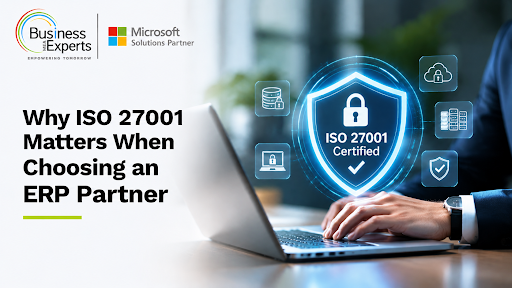
During implementation and ongoing support, ERP partners may access critical business systems and information. ISO 27001 certification provides an internationally recognised framework for managing these security risks through documented, independently audited processes. At BEMEA, we believe evaluating a partner’s information security practices is essential to building a reliable and secure business technology environment.
Understanding ISO 27001 and Its Role in ERP Implementation
ISO/IEC 27001 is an internationally agreed standard which sets the criteria for the development, implementation, maintenance and continual improvement of an Information Security Management System (ISMS). The standard is not specific to any one security tool or technical measure, but is instead a holistic approach to information security. It asks organisations to find out what might threaten it, what vulnerabilities it may have, what measures should be taken to address those vulnerabilities and how often to review the effectiveness of those measures.
An ERP implementation partner manages information security for its people, processes, technology and third-party relationships.
For an organization that manages ERP environments, there may be various moments when sensitive business information is at risk, ranging from the time of ERP system assessment through data migration, to the deployment and post-implementation support phase. ISO 27001 offers a structured approach to the risks that can be associated with information and sets accountability for information security. But, certification is not an assurance that nothing challenging can happen. It is important because it has the ability to prove that an organisation has an independently assessed information security management system and a process for managing and improving information security risk.
Five Reasons ISO 27001 Matters When Selecting an ERP Partner
Businesses must understand how a potential partner manages information security, protects sensitive data and addresses risks across connected systems. ISO 27001 provides a useful benchmark for this evaluation, with several benefits that directly influence the security and reliability of an ERP environment.
1. Protecting Sensitive Business and Financial Data
ERP systems bring together critical business information, including financial transactions, payroll details, customer records, supplier information and operational data. Since implementation partners may require access to these records during configuration, data migration, integrations and ongoing support, their security practices play an important role in protecting business information. An ISO 27001-aligned approach establishes structured controls to manage these risks.
Key security considerations include:
- Role-based access management: Ensures users and implementation teams access only the information required for their responsibilities.
- Authentication controls: Helps prevent unauthorised access to business applications and sensitive records.
- Secure data handling: Establishes procedures for protecting information during migration, storage and transfer.
- Incident response: Defines how potential security incidents are identified, reported and managed.
2. Reducing Third-Party and Supply Chain Security Risks
Every integration and external connection introduces potential security considerations. An ERP partner must therefore understand how it identifies and manages risks associated with third-party applications, service providers, and connected environments. ISO 27001 provides a structured approach to assessing these relationships and establishing appropriate safeguards.
This includes:
- Third-party risk assessments: Evaluating the security practices of external vendors and service providers.
- Supplier security controls: Defining responsibilities and security expectations when working with third parties.
- Integration security: Addressing potential vulnerabilities in connections between ERP systems and external applications.
- Data transfer protection: Establishing safeguards for information exchanged across different platforms and environments.
3. Supporting Regulatory and Contractual Requirements
Businesses operating across different markets must navigate data protection regulations, industry requirements and contractual security obligations. Depending on their location and sector, they may need to demonstrate appropriate controls for protecting sensitive information, managing access and maintaining audit records. Working with an ISO 27001-certified ERP partner can support these efforts by providing evidence of a structured information security management system.
The advantages include:
- Stronger compliance readiness: Supports the implementation of structured information security practices.
- Improved vendor assessments: Provides a recognised benchmark for evaluating a technology partner’s security management.
- Contractual alignment: Helps address information security expectations in enterprise agreements and supplier relationships.
- Audit preparedness: Supports documented processes and controls that can be reviewed during security assessments.
4. Establishing Accountability and Continuous Security Improvement
Information security is not a one-time implementation activity. New vulnerabilities, changing business requirements, evolving cyber threats and technology updates can introduce risks long after an ERP system goes live. ISO 27001 requires organisations to maintain and continually improve their Information Security Management System through risk assessments, internal audits, management reviews and corrective actions.
Businesses benefit from practices such as:
- Regular risk assessments: Identifying emerging threats and evaluating potential security weaknesses.
- Internal and external audits: Reviewing the effectiveness of information security controls.
- Management reviews: Ensuring information security remains an organisational priority.
- Corrective actions: Addressing identified gaps and improving existing security procedures.
- Ongoing monitoring: Reviewing security measures as systems, technologies and business requirements evolve.
5. Building Confidence Through Transparent Security Governance
Choosing an ERP partner involves placing considerable trust in an external organisation. Businesses need confidence that the partner understands its security responsibilities, manages access appropriately and follows documented procedures when handling sensitive information. ISO 27001 promotes clear and articulated security responsibilities, documented policies, risk assessments and independent audits.
Businesses can look for the following:
- Clearly defined responsibilities: Understanding who is accountable for information security within the partner organisation.
- Documented security policies: Reviewing how information security requirements are established and communicated.
- Certification verification: Checking the validity, scope and issuing body of the ISO 27001 certificate.
- Audit transparency: Understanding how security controls are reviewed and independently assessed.
- Long-term commitment: Evaluating how the partner maintains and improves its security practices beyond implementation.
What Should Businesses Check Before Choosing an ISO 27001-Certified ERP Partner?
Certification is an important starting point, but businesses should look beyond the presence of an ISO 27001 logo or certificate.
During the vendor evaluation process, consider the following:
- Certification validity and scope: Verify that the certificate is current, issued by an appropriately accredited certification body and covers the services and locations relevant to the engagement.
- Data access and management: Understand how the partner accesses, processes, stores and protects business information during implementation and support.
- Third-party integrations: Evaluate how the partner manages security risks associated with external applications, vendors and connected systems.
- Incident response procedures: Ask how security incidents are identified, reported, investigated and managed.
- Ongoing security reviews: Understand how the partner monitors risks, reviews controls and maintains its information security practices.
Choosing an ERP Partner with Security at Its Core
Implementing ERP is a long-term business decision. The right partner should have so much more than platform knowledge and implementation skills. It should grasp the value of safeguarding business data, dealing with technology risks, and ensuring secure systems throughout their lifecycle.
Our expertise at BEMEA extends across the Microsoft Dynamics 365 platform, Power BI analytics, Azure cloud solutions and the larger Microsoft Power Platform. As a Microsoft Partner, we help businesses implement and optimise technology solutions that support their operational and strategic objectives. We understand that the successful ERP environment requires the blending of functionality, integration, performance and security.